
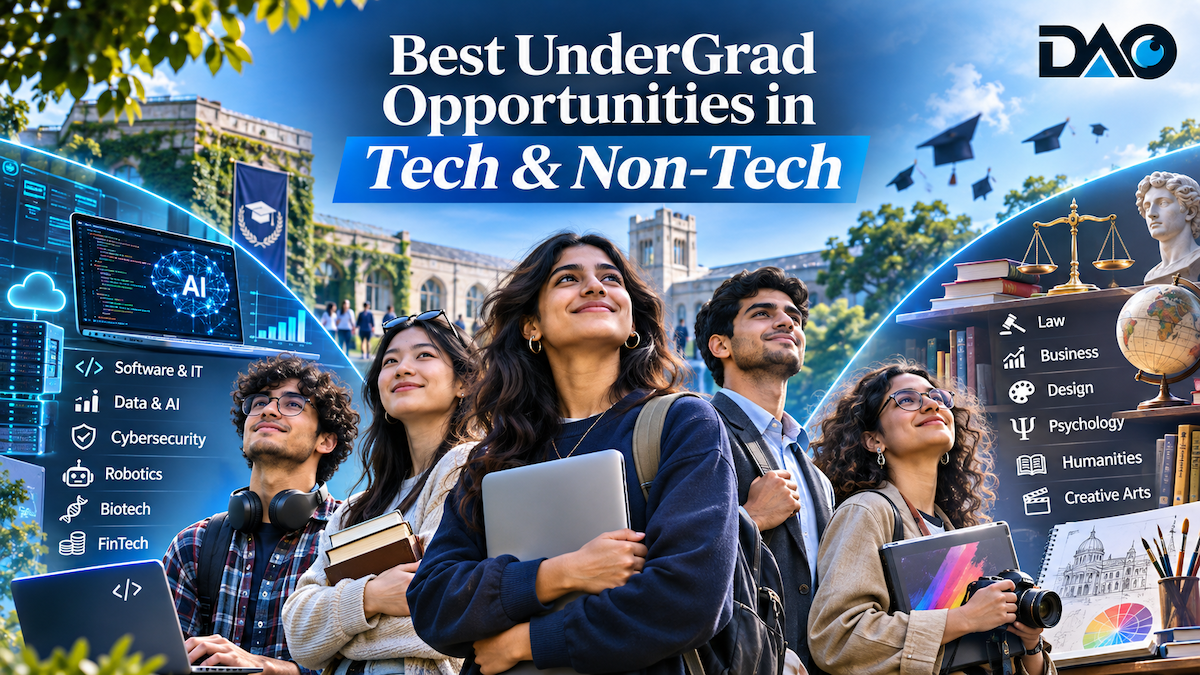
From artificial intelligence and cybersecurity to psychology, economics, law and creative industries, choosing the right undergraduate programme has become one of the most important career decisions for young students.
Digital Assets Observer | Education & Careers | November 2026
Introduction: Why the Undergraduate Degree Is Being Redefined
The traditional question of whether a student should pursue engineering, medicine, commerce or humanities is becoming increasingly inadequate. As artificial intelligence transforms workplaces, digital technology reshapes industries and employers place greater emphasis on practical competence, undergraduate education is entering a period of significant change.
For students planning university admissions in 2027, the challenge is not simply to select a prestigious institution or a fashionable degree. The more important task is to identify an academic pathway that combines employability, intellectual development, financial affordability and opportunities for future specialization.
The World Economic Forum’s Future of Jobs Report 2025 identifies artificial intelligence, big data, cybersecurity and technological literacy among the fastest-growing skills. Equally important are analytical thinking, creative problem-solving, resilience and leadership.
These findings highlight a fundamental shift: technology skills are becoming indispensable, but human judgment, communication, domain knowledge and creativity continue to carry substantial value.
India presents particularly interesting opportunities. The country’s expanding digital economy, healthcare infrastructure, financial services industry, manufacturing sector and startup ecosystem are creating demand for professionals across both technical and non-technical disciplines.
Explore the best undergraduate courses for 2027 in AI, engineering, business, psychology, law and humanities, with career prospects and admission guidance.
Students therefore need to evaluate undergraduate courses through a broader framework, rather than treating science degrees as inherently superior to humanities or commerce degrees.
1. Computer Science and Artificial Intelligence: Strong Foundations for the Digital Economy
Computer science remains one of the most versatile undergraduate disciplines because it creates pathways into software development, cloud computing, artificial intelligence, financial technology, cybersecurity and technology entrepreneurship.
Popular academic options include:
- B.Tech in Computer Science and Engineering
- B.Tech in Artificial Intelligence and Machine Learning
- B.Sc. Computer Science
- BCA, or Bachelor of Computer Applications
- Undergraduate programmes specializing in data science
However, students should not assume that a degree carrying an artificial intelligence label automatically offers better employment opportunities than a conventional computer science degree.
A strong curriculum should include programming fundamentals, algorithms, data structures, mathematics, databases, operating systems, software engineering and practical projects.
Artificial intelligence specialization becomes more valuable when it is built upon these foundations.
Career opportunities
Graduates can pursue roles in software engineering, AI development, machine learning operations, cloud infrastructure, technology consulting and product development.
Students interested in entrepreneurship may also develop applications, digital services, automation solutions or software products.
What should students examine before admission?
The quality of faculty, academic infrastructure, internship opportunities, laboratory facilities, industry relationships and graduate employment outcomes can matter more than a programme’s marketing language.
2. Cybersecurity and Digital Forensics: Careers Beyond Conventional IT
As enterprises expand their digital infrastructure, the importance of protecting information systems continues to increase.
Cybersecurity is particularly relevant to financial institutions, healthcare organizations, government agencies, e-commerce companies and cloud service providers.
Students can pursue computer science programmes with cybersecurity electives or specialized undergraduate qualifications where the curriculum is sufficiently rigorous.
Core subjects should include networking, operating systems, cryptography, secure programming, incident response, cyber law and ethical security testing.
Potential careers include security analyst, penetration tester, digital forensics specialist, cloud security professional and security operations analyst.
The sector also offers opportunities for professionals combining technology knowledge with legal, regulatory or risk-management expertise.
Importantly, cybersecurity professionals require continuous learning. Professional certifications and practical experience can complement a degree but should not replace a sound academic foundation.
3. Data Science, Statistics and Applied Mathematics
Data science is sometimes presented as a purely programming-oriented field. In reality, statistics and mathematics are equally important.
Organizations increasingly use data analysis for customer insights, financial modeling, logistics optimization, medical research, advertising measurement and operational forecasting.
Promising undergraduate routes include B.Sc. Statistics, B.Sc. Mathematics, B.Tech Data Science, economics with quantitative electives and computer science with analytics specialization.
A student who develops strong mathematical reasoning, Python or R programming, statistical modeling and visualization skills may have opportunities across multiple industries.
Possible career pathways include data analyst, business intelligence analyst, quantitative researcher and, with further specialization, data scientist.
Students should recognize that advanced machine learning and research positions may require postgraduate qualifications or substantial specialized experience.
4. Electronics, Robotics and Semiconductor Engineering
Although software attracts considerable attention, the physical infrastructure supporting digital transformation remains essential.
Semiconductors, electronic systems, telecommunications equipment, industrial automation and embedded computing are central to technological development.
Undergraduate disciplines worth considering include Electronics and Communication Engineering, Electrical Engineering, Mechatronics, Instrumentation and Robotics.
Career possibilities include chip design, embedded systems, automation, hardware verification, robotics integration and industrial research.
Students considering these fields should examine laboratory access, industry collaboration, practical training and opportunities for higher education.
The combination of electronics knowledge with programming and artificial intelligence can be especially useful in interdisciplinary technology roles.
5. Renewable Energy, Environmental Science and Sustainability
The energy transition is creating demand for professionals who understand electricity systems, environmental assessment, materials science, climate risks and sustainable business practices.
Relevant degree options include electrical engineering, environmental engineering, environmental science, chemical engineering and energy-related specializations.
Graduates may pursue careers in renewable energy development, energy auditing, sustainability reporting, environmental consulting and infrastructure planning.
However, broad claims about guaranteed green-sector employment should be treated cautiously. Career prospects vary considerably by qualification, location and experience.
6. Business Administration, Economics and Finance
Non-technical undergraduate degrees can provide attractive opportunities, particularly when supported by quantitative abilities and practical business exposure.
BBA, B.Com., BA Economics and B.Sc. Economics are among the principal options.
Economics students develop an understanding of markets, policy, incentives, statistics and economic decision-making.
Commerce students study financial accounting, taxation, corporate finance, auditing and business regulation.
Business administration programmes generally emphasize management, marketing, operations, entrepreneurship and organizational behavior.
Possible career paths include financial analysis, banking, consulting, marketing, business development, operations and entrepreneurship.
Additional qualifications such as CA, CFA, actuarial studies, financial modeling or an MBA may open more specialized pathways, depending on eligibility and professional requirements.
Economics versus BBA: Which is better?
Economics may appeal to students who enjoy analytical reasoning, mathematics, public policy and research.
BBA may be more suitable for students interested in business operations, marketing, management and entrepreneurship.
Neither qualification guarantees superior earnings. University quality, student competence, internships and subsequent professional development are more meaningful indicators.
7. Psychology and Behavioral Science
Psychology is attracting interest because human behavior influences healthcare, education, workplace management, digital product design, marketing and social services.
Undergraduate psychology programmes typically introduce cognitive psychology, developmental psychology, social psychology, research methods and statistics.
Career opportunities may develop in human resources, behavioral research, market research, user experience research and educational services.
Students should distinguish these pathways from regulated clinical practice.
An undergraduate psychology degree alone does not qualify someone to practice as a clinical psychologist in India. Such roles require the applicable recognized professional qualifications and regulatory compliance.
Psychology becomes particularly valuable when combined with data analysis, economics, neuroscience, communication or technology.
8. Law and Public Policy
Legal education offers opportunities extending beyond traditional courtroom practice.
Corporate law, intellectual property, technology regulation, privacy, arbitration, financial compliance and policy research are increasingly interdisciplinary fields.
Students may consider five-year integrated programmes such as BA LL.B. or BBA LL.B. after Class 12.
Admission routes can include CLAT, AILET or institution-specific examinations, depending on the university.
Graduates may pursue legal practice, corporate advisory, compliance, policy research, legal journalism and other roles.
Students should verify that their chosen law programme has the recognition required for their intended professional pathway.
9. English, Journalism, Media and Communication
The growth of artificial intelligence has raised questions about the future of writing and media professions.
Yet organizations continue to require editorial judgment, fact-checking, communication strategy, research, storytelling and reputation management.
Undergraduate degrees in English, journalism, mass communication and media studies can provide foundations for careers in publishing, digital journalism, communications, public relations and content strategy.
The strongest candidates are likely to combine writing and research capabilities with multimedia production, digital analytics, verification skills and responsible use of AI tools.
An English graduate with technical literacy and business understanding may find opportunities that extend far beyond traditional teaching or publishing.
Students interested in India’s business and entrepreneurial ecosystem can also explore industry publications such as SMEStreet to understand real-world developments in small business, innovation, management and economic policy.
10. Design, User Experience and Creative Technology
Design is no longer confined to fashion, graphics or physical products.
User experience design, interaction design, animation, game design, service design and product design connect creativity with commercial and technological requirements.
Common routes include Bachelor of Design programmes, architecture, visual communication and digital media programmes.
Students should assess portfolios, studios, faculty expertise and the nature of industry projects.
Unlike some examination-driven fields, design careers frequently depend on demonstrable work.
A strong portfolio of research, prototypes and completed projects can be more persuasive than a collection of generic certificates.
11. Healthcare, Biotechnology and Allied Health
Healthcare offers diverse undergraduate possibilities beyond the MBBS degree.
Options include nursing, pharmacy, physiotherapy, biotechnology, medical laboratory technology, nutrition and other allied health disciplines.
These fields may provide pathways into hospitals, diagnostics, pharmaceutical companies, research organizations and health technology.
However, professional recognition is crucial. Students should check the applicable regulator, institution approvals and professional registration requirements before enrolling.
For biotechnology and research-intensive careers, postgraduate education is often important.
12. Studying in India Versus Studying Abroad
India offers a wide spectrum of higher education institutions, including IITs, NITs, IIITs, central universities, state universities, specialized institutes and private universities.
International destinations such as the United States, United Kingdom, Canada, Germany, France, Australia and Singapore offer different academic environments and research opportunities.
But studying abroad should be evaluated through total cost, not university reputation alone.
Students should calculate tuition fees, housing, insurance, transport, visa expenses, exchange-rate exposure and potential borrowing costs.
Scholarships, financial aid, cooperative education programmes and research opportunities may improve affordability, but their availability varies substantially.
A prestigious foreign qualification financed through excessive debt may create financial pressure if expected employment outcomes do not materialize.
Conversely, an affordable Indian undergraduate degree followed by a targeted international master’s programme may be an effective alternative for some students.
13. How Should Students Choose a University?
A systematic comparison can prevent costly mistakes.
Students should investigate institutional recognition, accreditation, curriculum structure, faculty profiles, internship support, academic flexibility and verifiable placement data.
Placement figures deserve particular scrutiny. The highest package advertised by an institution does not necessarily represent the typical graduate outcome.
Median compensation, number of students placed, internship quality and postgraduate progression can provide a more balanced picture.
Students should also examine whether the university offers interdisciplinary electives, industry projects, research opportunities and entrepreneurship support.
14. Undergraduate Admission Pathways for 2027
Students planning admission in 2027 should monitor the official examination and admission portals rather than relying on previous-year schedules.
Important routes include:
- JEE Main and JEE Advanced for relevant engineering admissions
- CUET-UG for participating university programmes
- NEET-UG for applicable medical courses
- CLAT and AILET for participating law institutions
- UCEED and NID entrance processes for applicable design courses
- University-specific entrance examinations and merit-based admissions
Eligibility requirements, participating institutions, examination patterns and deadlines can change.
Students should build a shortlist early, identify entrance subjects, prepare academic documents and examine scholarship eligibility.
Useful official resources include NTA, CUET-UG and the admission websites of individual universities.
15. The Most Important Career Strategy: Combine Disciplines
Future employability may depend less on choosing between technical and non-technical education and more on combining complementary skills.
Examples include:
- Economics with data analytics
- Psychology with user experience research
- English with digital communication and AI literacy
- Computer science with financial technology
- Law with cybersecurity and data protection
- Design with entrepreneurship
- Environmental science with business management
The objective is not to pursue every available certificate. It is to develop a coherent professional profile.
Students should graduate with foundational academic knowledge, practical work samples, communication ability and the capacity to learn new technologies.
Frequently Asked Questions
Which undergraduate course offers the best career opportunities in 2027?
Computer science, AI-related programmes, quantitative disciplines, healthcare and specialized business courses offer significant possibilities. However, the best choice depends on individual aptitude, university quality and career objectives.
Are non-technical degrees valuable in the age of AI?
Yes. Economics, psychology, law, design, communication and management remain relevant. Their value can increase when students develop technological literacy and analytical skills.
Is a BCA better than B.Tech Computer Science?
They serve overlapping but different academic routes. B.Tech usually offers a broader engineering framework, while BCA emphasizes computer applications. Curriculum quality and practical competence should guide the comparison.
Can humanities students enter technology-related careers?
Yes. Humanities graduates can enter fields such as UX research, technology policy, digital communication, product operations and business analysis, although specialized technical positions may require additional training.
Is studying abroad worth the investment?
It depends on programme quality, funding, career outcomes and long-term financial implications. Students should assess total expenditure and realistic employment pathways before committing.
Conclusion
The best undergraduate education opportunity in 2027 will not necessarily be the degree with the most fashionable title or the university with the highest advertised salary.
It will be the programme that combines academic strength, practical exposure, affordability, professional relevance and the flexibility to adapt to future change.
For students and parents, the most effective strategy is to evaluate education as a long-term investment in capability rather than a short-term competition for admission.
Editorial note: Career demand projections are not employment guarantees. Admissions, accreditation and scholarship eligibility should be verified with the relevant institutions and authorities before applying.






Leave a Reply