
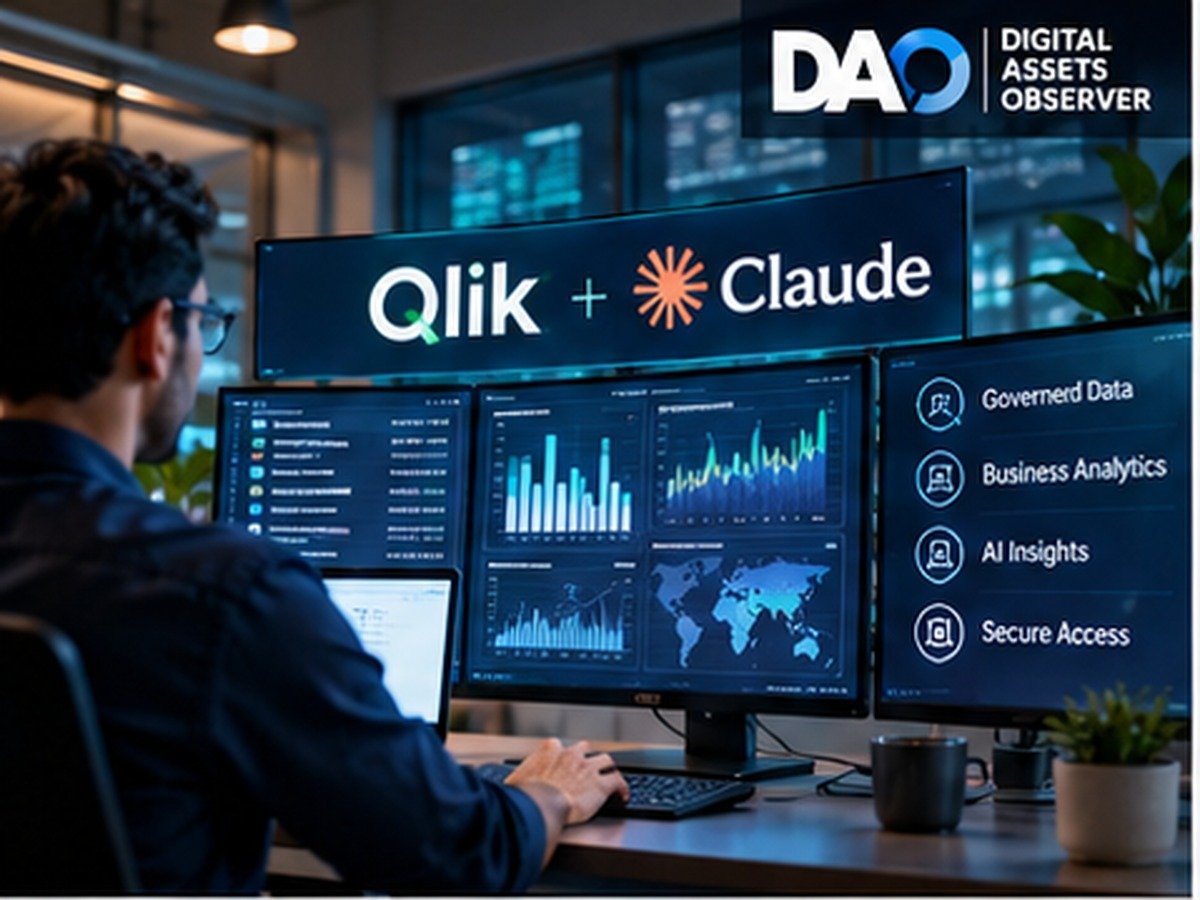
Enterprise analytics company Qlik has announced that its Model Context Protocol (MCP) server is now available through Anthropic’s Claude Directory, creating a new route for businesses to connect AI assistants with governed corporate data and established analytical workflows.
The announcement reflects an important shift in enterprise artificial intelligence. As companies move beyond experimenting with generative AI, the challenge increasingly involves connecting intelligent assistants to reliable information, established business processes and appropriate access controls.
Qlik’s integration is designed to address this requirement by allowing Claude to work with analytical context already available within Qlik Cloud.
Bringing business context into AI conversations
Large language models can interpret natural-language questions and generate useful explanations. However, their usefulness in business environments depends heavily on the quality and relevance of the information available to them.
An AI assistant answering a sales-performance question, for example, needs more than a spreadsheet containing transactions. It must understand how the organisation defines revenue, which transactions qualify for reporting, and which information the requesting employee is authorised to access.
Qlik says its MCP server makes governed datasets, business metrics, analytical expressions and lineage information accessible to Claude.
Rather than requiring organisations to reconstruct business logic inside individual prompts, the integration is intended to make existing analytical definitions available through a standardised connection.
What the MCP integration enables
According to Qlik, the integration supports several enterprise activities, including:
- Searching analytical applications, datasets and data products.
- Asking natural-language questions using governed business information.
- Examining analytical expressions and scripts.
- Creating dashboards, visualisations and analytical content through prompts.
- Accessing information within existing Qlik Cloud permission structures.
The company says OAuth-based authentication and established access controls are part of the integration.
These capabilities could make conversational analytics more practical for employees who do not regularly work with specialist business intelligence software.
Why data governance matters
A major concern surrounding enterprise AI is the possibility of incorrect, outdated or unauthorised information influencing automated decisions.
Data governance helps organisations define how information is collected, maintained, accessed and interpreted. Lineage information can also help establish where particular data originated and how it was transformed.
Qlik’s approach is to connect Claude with this existing analytical environment rather than treating corporate information as an unstructured collection of records.
The distinction is significant for organisations using AI to support financial reporting, operational planning, customer analysis and management decisions.
However, governed access does not eliminate every risk. Organisations must still validate AI-generated conclusions, assess permissions and monitor how sensitive information is handled.
From conversational answers to analytics workflows
The integration also highlights the growing importance of AI systems capable of performing actions rather than simply generating responses.
An employee might eventually use a conversational interface to locate a relevant dataset, examine a business metric and prepare a visualisation without manually navigating several separate applications.
Such workflows could reduce the technical barriers associated with business intelligence tools.
Their effectiveness, however, will depend on implementation quality, data readiness, user permissions and the accuracy of generated analytical outputs.
Qlik’s enterprise AI strategy
Qlik has positioned trusted data products and analytics as important components of its broader AI strategy.
By making its MCP server available through Claude Directory, the company is seeking to participate in an ecosystem where enterprise users can connect AI assistants with specialised business systems.
For organisations, this represents another option for integrating AI into existing technology investments without necessarily replacing their underlying analytics platforms.
The larger industry implication
The next stage of enterprise AI adoption may be determined less by which assistant produces the most convincing answer and more by which systems can reliably access approved information and complete useful tasks.
Integrations such as Qlik’s Claude connection demonstrate how data governance, business intelligence and conversational AI are beginning to converge.
For businesses considering similar technologies, the practical questions remain straightforward: whether the system can access the right data, respect existing controls, produce dependable analysis and deliver measurable operational value.












Leave a Reply