

Three Taj hotels, two Vivanta properties, one Gateway and two Ginger hotels will strengthen India’s airport-linked hospitality infrastructure as Adani Airport City advances its ₹20,000-crore-plus first-phase development programme.
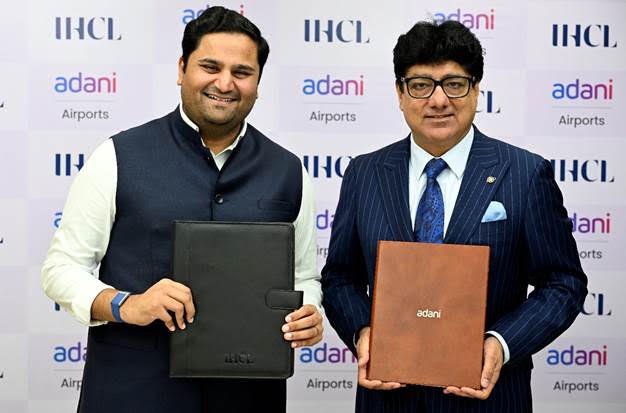
Mumbai, October 29, 2026: India’s airport infrastructure is entering a new phase of integrated commercial development, with Indian Hotels Company Limited (IHCL) and Adani Airport Holdings Limited (AAHL) announcing a multi-hotel operating agreement covering eight hotels and more than 2,000 rooms across Mumbai, Ahmedabad, Lucknow and Guwahati.
The agreement brings together two major Indian business groups with complementary interests in hospitality, aviation infrastructure and airport-led urban development.
Under the arrangement, AAHL will develop the hotel properties, while IHCL will operate them through its Taj, Vivanta, Gateway and Ginger brands.
The development represents a significant addition to India’s airport hospitality ecosystem, potentially serving international travellers, domestic passengers, corporate visitors, airline-related travel requirements and leisure tourists.
For the Indian hospitality industry, the agreement also illustrates how airports are increasingly evolving beyond transport infrastructure into integrated commercial destinations.
Eight Hotels Across Four Strategic Aviation Gateways
The planned portfolio will comprise three Taj hotels, two Vivanta hotels, one Gateway hotel and two Ginger hotels.
The properties will be located across four cities that play important roles in India’s domestic and international aviation connectivity.
The proposed distribution is as follows:
| City | Hotel brands | Properties |
|---|---|---|
| Mumbai | Taj | 1 |
| Ahmedabad | Taj, Vivanta | 2 |
| Lucknow | Vivanta, Ginger | 2 |
| Guwahati | Taj, Gateway, Ginger | 3 |
| Total | 8 |
Together, the hotels will offer more than 2,000 rooms, alongside dining, meeting and event spaces, wellness facilities and recreational amenities.
The portfolio will address different consumer requirements, ranging from luxury accommodation and upscale hospitality to more accessible midscale hotel experiences.
The multi-brand approach is particularly relevant to airport-linked developments, where travellers may have substantially different budgets, trip durations and accommodation preferences.
IHCL and Adani Airports Sign Landmark Agreement for Eight Hotels Across Four Indian Cities, Adding Over 2,000 Rooms
Mumbai: Taj Hotel Planned at Terminal 2
Mumbai will feature a Taj hotel currently under construction at Terminal 2 of Mumbai Airport, according to the announcement.
The property is expected to strengthen premium hospitality infrastructure at one of India’s major aviation gateways.
Airport-linked hotels can serve several categories of travellers, including passengers with extended layovers, visitors attending business meetings, international tourists and professionals travelling on short assignments.
For a major metropolitan economy such as Mumbai, additional high-quality hotel infrastructure could also support business events and corporate travel.
However, the agreement does not specify a confirmed opening date or room count for the individual Mumbai property.
Ahmedabad: Taj and Vivanta Projects in Advanced Construction
Ahmedabad will receive two properties under the agreement: a Taj hotel and a Vivanta hotel.
The company announcement states that both properties are in advanced stages of construction.
Ahmedabad has an important commercial and industrial presence, supported by manufacturing businesses, financial activities, exhibitions and domestic business travel.
The planned hotels could add to the city’s accommodation capacity across luxury and upscale segments.
For IHCL, the combination of Taj and Vivanta allows the company to serve distinct traveller groups while maintaining a presence within the same broader airport ecosystem.
Lucknow: Vivanta and Ginger to Support Diverse Travel Demand
The Lucknow development will include a Vivanta hotel and a Ginger hotel.
This combination reflects a strategy of addressing different hospitality segments within the same destination.
Vivanta serves the upscale hospitality market, while Ginger targets the midscale segment.
Lucknow’s role as an administrative, commercial and cultural centre creates demand from government-related travel, business visitors and leisure tourists.
Additional airport-linked accommodation could benefit travellers seeking convenient access to aviation infrastructure and the city.
For the regional tourism economy, such investment may also support hospitality-related employment and demand for local services.
Guwahati: Three Hotels to Strengthen the Northeast’s Aviation Gateway
Guwahati will receive the largest number of properties under the eight-hotel agreement.
The city will feature one Taj hotel, one Gateway hotel and one Ginger hotel.
The three-brand development highlights Guwahati’s importance as an aviation gateway for India’s northeastern region.
The city provides access to multiple tourism destinations and serves as a commercial centre for the region.
The inclusion of luxury, full-service and midscale hospitality brands could create accommodation choices for business visitors, tourists and transit passengers.
Greater hospitality capacity may also complement the development of regional tourism and commercial infrastructure.
However, the eventual impact will depend on travel demand, project execution and broader regional economic conditions.
Adani Airport City: A ₹20,000-Crore-Plus Development Vision
The IHCL agreement forms part of AAHL’s larger strategy to develop integrated airport-linked commercial districts.
According to the announcement, AAHL has established Adani Airport City Limited to develop a land bank exceeding 655 acres across six airports in five states.
This includes nearly 440 acres in Mumbai and Navi Mumbai.
In its first phase, Adani Airport City plans to invest more than ₹20,000 crore to develop approximately 22 million square feet across Mumbai, Navi Mumbai, Ahmedabad, Lucknow, Jaipur and Guwahati.
The development vision extends beyond hotels.
The airport cities are intended to bring together hospitality, retail, business facilities, entertainment, lifestyle infrastructure and other commercial activities.
The ₹20,000-crore-plus figure relates to the broader first-phase Airport City development programme, not exclusively to the eight hotels covered by the IHCL agreement.
The companies have not disclosed a separate investment amount for the hotel operating agreement.
Why Airport Cities Are Emerging as New Commercial Hubs
Globally, the commercial role of airports has expanded substantially.
Major aviation gateways increasingly incorporate hotels, conference facilities, restaurants, retail centres and business infrastructure alongside passenger terminals.
This approach can help airports serve travellers and businesses more comprehensively.
Airport-linked hospitality can be particularly relevant to cities experiencing increasing business activity, tourism development and changing travel patterns.
Hotels located close to airports may provide convenience to short-duration visitors and travellers with demanding schedules.
They may also support business conferences, meetings and events that benefit from proximity to transport infrastructure.
From an infrastructure perspective, the development model creates opportunities to combine aviation connectivity with other commercial activities.
IHCL Strengthens Its Multi-Brand Airport Presence
The agreement is an important addition to IHCL’s hospitality network.
Puneet Chhatwal, Managing Director and Chief Executive Officer of IHCL, highlighted the growing relevance of airport-centric developments.
He described such projects as emerging commercial and hospitality hubs within India’s expanding aviation market.
According to IHCL, the partnership will increase the company’s presence to 25 hotels across its brands at key airports in India.
The eight new properties will extend the company’s multi-brand strategy across luxury, upscale and midscale categories.
This approach allows IHCL to target different customer segments while drawing on its established hospitality operations.
Adani Airports Looks Beyond Aviation Operations
AAHL’s wider development strategy indicates that the company is pursuing a broader role in airport-linked urban infrastructure.
Jeet Adani, Director of Adani Airport Holdings Limited, described the company’s ambition as developing vibrant Airport Cities that integrate hospitality, business, retail and leisure facilities.
The strategy seeks to position airports as catalysts for tourism, commerce and urban growth.
For AAHL, the collaboration with IHCL provides an established hospitality operating partner for the hotel component of its mixed-use development plans.
The arrangement separates the responsibilities of developing hotel assets and operating them under established hospitality brands.
What the Agreement Means for India’s Travel and Tourism Industry
The planned addition of more than 2,000 rooms could support the availability of airport-linked accommodation in four important cities.
The inclusion of multiple hotel brands may also broaden consumer choice.
For travellers, potential benefits include improved access to hotels near airports, accommodation options across price segments and greater availability of facilities for business meetings and events.
For regional economies, hotel construction and operations can generate opportunities for employment and local suppliers.
Restaurants, logistics providers, maintenance businesses, tourism operators and other service companies may also benefit from hospitality investment, depending on project procurement and operating arrangements.
Nevertheless, these outcomes depend on the successful development and operation of the properties.
Investment Implications for IHCL and Adani Enterprises
The announcement is relevant to investors following India’s hospitality, aviation and infrastructure sectors.
IHCL’s operating role in the planned properties reflects its strategy of expanding through a portfolio of differentiated hotel brands.
For AAHL, the agreement supports the commercial development of its Airport City infrastructure.
AAHL is part of Adani Enterprises Limited, the flagship company of the Adani Group.
However, the announcement does not disclose the specific financial terms of the hotel operating agreement, projected hotel-level revenue or expected investment returns.
Investors should therefore avoid treating the agreement itself as evidence of a particular earnings contribution.
Important factors to monitor include property completion timelines, opening dates, demand conditions, occupancy, average room rates and the contractual economics of the operating arrangement.
The performance of the broader Airport City development programme will also depend on capital allocation, execution and commercial demand.
Opportunities for Indian Hospitality and Infrastructure Businesses
Large airport-linked developments can create opportunities beyond the primary project participants.
Construction companies, building technology providers, furniture suppliers, hospitality equipment companies, digital infrastructure providers and facility-management businesses may participate in the associated supply chains.
Hotel operations can also generate demand for food services, security, transportation, laundry, maintenance and other recurring services.
For smaller businesses, access to such opportunities will depend on procurement requirements, commercial competitiveness and the actual development schedules.
The wider significance of the agreement therefore extends into India’s hospitality and infrastructure value chains.
Digital Transformation in Airport-Linked Hospitality
Modern hotels increasingly rely on digital booking platforms, property-management systems, electronic payments, revenue-management technology and connected guest services.
Integrated airport hospitality developments may create opportunities for closer coordination between traveller services and hotel operations.
Such possibilities could include more convenient reservations, digital check-in and improved coordination of transport-related information.
However, the IHCL-AAHL announcement does not specify any particular new digital platform or technology integration.
These remain broader industry opportunities rather than confirmed deliverables under the agreement.
India’s Hospitality Expansion Enters a New Phase
The collaboration reflects the convergence of two important trends: the expansion of India’s aviation infrastructure and the development of differentiated hospitality capacity.
For IHCL, the eight-property agreement strengthens its presence at major aviation gateways.
For Adani Airports, the partnership advances a strategy of transforming selected airport locations into integrated commercial and lifestyle destinations.
The planned hotels across Mumbai, Ahmedabad, Lucknow and Guwahati could become important components of the evolving airport hospitality landscape.
The central test will be how successfully the developments translate infrastructure investment into attractive, accessible and commercially sustainable destinations for travellers.
As India’s airport infrastructure continues evolving, partnerships between aviation operators and established hospitality companies may play an increasingly visible role in shaping the country’s travel ecosystem.













Leave a Reply