
New AI service offers developers access to multiple open-weight models through one API, targeting enterprise applications, coding agents and AI workloads requiring India-hosted computing infrastructure.
Digital Assets Observer | New Delhi | November 3, 2026
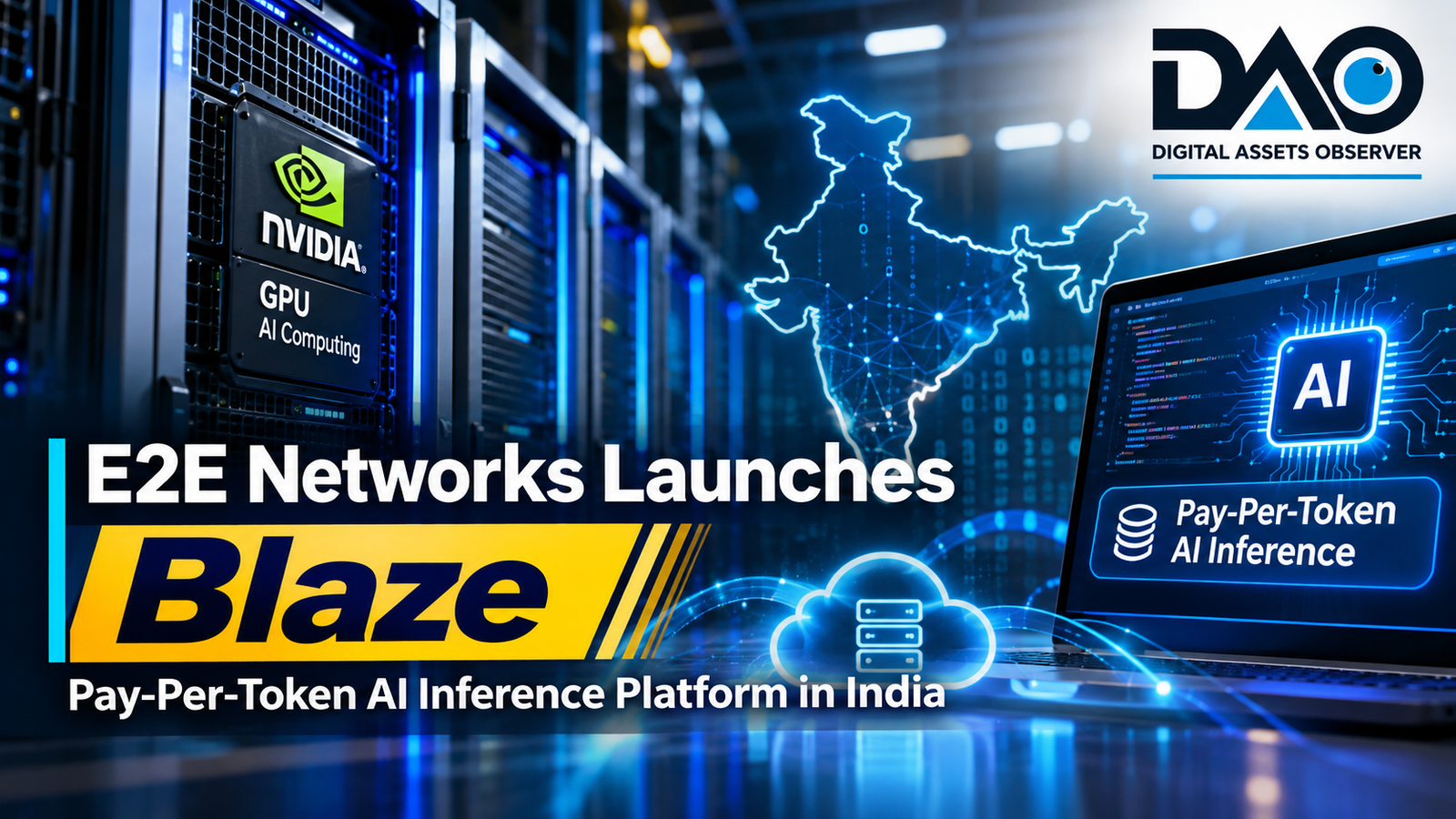
India’s artificial intelligence infrastructure ecosystem has received a new addition with E2E Networks Limited announcing the launch of Blaze, a pay-per-token inference platform intended to simplify enterprise access to powerful open-weight AI models.
Launched on November 2, 2026, the service allows developers and organizations to access multiple AI models through a single OpenAI-compatible application programming interface.
Built using components of NVIDIA DSX OS and powered by NVIDIA GPU infrastructure hosted in India, Blaze is designed to help businesses deploy AI applications without individually managing all aspects of model hosting and computational scaling.
The development is particularly relevant as Indian enterprises increasingly move from experimental generative AI projects toward operational deployment.
Why AI Inference Has Become a Critical Market
Artificial intelligence infrastructure has traditionally attracted attention for the computing power required to train large language models.
However, once models are trained, running them efficiently for millions of users creates a different challenge.
This operational phase, known as inference, involves processing requests and generating model responses.
The costs can become substantial when businesses deploy AI-driven applications that continuously process documents, respond to customers, generate software code or operate autonomous agents.
As AI adoption expands, the economics of inference are becoming an important consideration for enterprise technology budgets.
E2E Networks is positioning Blaze around this challenge by introducing consumption-based pricing.
Under its announced model, users pay according to eligible token consumption rather than necessarily maintaining dedicated GPU resources for every application.
This could provide additional flexibility for companies whose computational requirements fluctuate.
However, the actual cost advantage depends on model pricing, application architecture, token usage, latency and alternative infrastructure arrangements.
Access to Multiple Open AI Models
Blaze is designed to provide access to several established model families, including NVIDIA Nemotron, Sarvam, DeepSeek, Qwen, GLM and Gemma.
The availability of different models can support organizations seeking to select AI systems according to language support, reasoning requirements, computing efficiency or application-specific performance.
An OpenAI-compatible interface also offers potential advantages for developers who already use applications built around similar API conventions.
Compatibility does not necessarily mean every capability or endpoint behaves identically, and developers will need to test integrations.
The announcement signals an effort to reduce the operational complexity of deploying open-weight artificial intelligence.
The Importance of India-Hosted AI Computing
One of Blaze’s major positioning points is that its infrastructure is hosted in India.
Domestic AI computing has particular relevance for organizations concerned with data location, infrastructure governance, latency and operational control.
Financial institutions, healthcare companies and public-sector organizations may face additional requirements concerning how information is stored and processed.
Nevertheless, domestic hosting alone does not guarantee regulatory compliance.
Businesses must independently assess their legal responsibilities, contractual protections, access controls, security arrangements and data-processing practices.
NVIDIA Technology Behind the Platform
According to the company, Blaze uses NVIDIA Dynamo-based model serving and other infrastructure components intended to optimize GPU utilization and inference workloads.
The architecture incorporates technologies designed to improve model-serving efficiency and coordinate computational resources.
This matters because inference performance is not determined solely by the number of available GPUs.
Efficient workload scheduling, memory management, caching and distributed processing can have significant effects on response times and operating costs.
E2E Networks also operates its TIR platform, which supports additional AI infrastructure requirements, including training, fine-tuning and managed model deployment.
Together, the platforms are intended to support different stages of the AI development lifecycle.
Expansion of E2E Networks’ AI Capacity
The company has indicated that its AI factory capacity is expanding toward approximately 14.6 MW.
Its announcement also refers to a 1,024-GPU NVIDIA Blackwell cluster that became operational in May 2026, alongside further planned or developing Blackwell infrastructure.
These investments highlight the capital-intensive nature of competing in AI cloud infrastructure.
GPUs, power availability, cooling, networking and system management are increasingly important components of the AI industry.
The commercial success of such infrastructure depends on utilization, customer demand, pricing and operating efficiency.
Implications for Indian Startups and Enterprises
For Indian AI startups, Blaze could represent an additional option for deploying applications without committing immediately to dedicated infrastructure.
Developers working on Indian-language assistants, document-processing systems, voice interfaces or enterprise automation may benefit from comparing managed inference services with self-hosted alternatives.
Large organizations may evaluate the service in the context of broader cloud and AI procurement strategies.
Potential evaluation criteria include performance, price per million tokens, reliability, model availability, security controls, contractual terms and support arrangements.
The announcement does not, by itself, establish that Blaze will be cheaper or faster than competing providers across every workload.
Independent benchmarking will be necessary.
Investor Perspective: Product Launch Versus Financial Performance
E2E Networks is listed on Indian stock exchanges under the symbol E2E.
The launch potentially expands its participation in the AI infrastructure value chain, but investors should distinguish technological announcements from demonstrated financial outcomes.
Key indicators to monitor include customer adoption, recurring revenue, gross margins, capital expenditure, infrastructure utilization and cash flow.
A successful product launch may create commercial opportunities without guaranteeing near-term profitability.
Conclusion
Blaze illustrates how India’s AI market is evolving beyond computing infrastructure acquisition toward services that make AI models easier to operate in production.
As inference-intensive applications expand, demand for cost-efficient, reliable and appropriately governed AI computing could become increasingly important.
For E2E Networks, the central question is whether its India-hosted infrastructure can translate into sustainable customer adoption and economically competitive inference services.
The platform’s long-term significance will ultimately depend on measurable performance, reliability and commercial execution.










Leave a Reply