
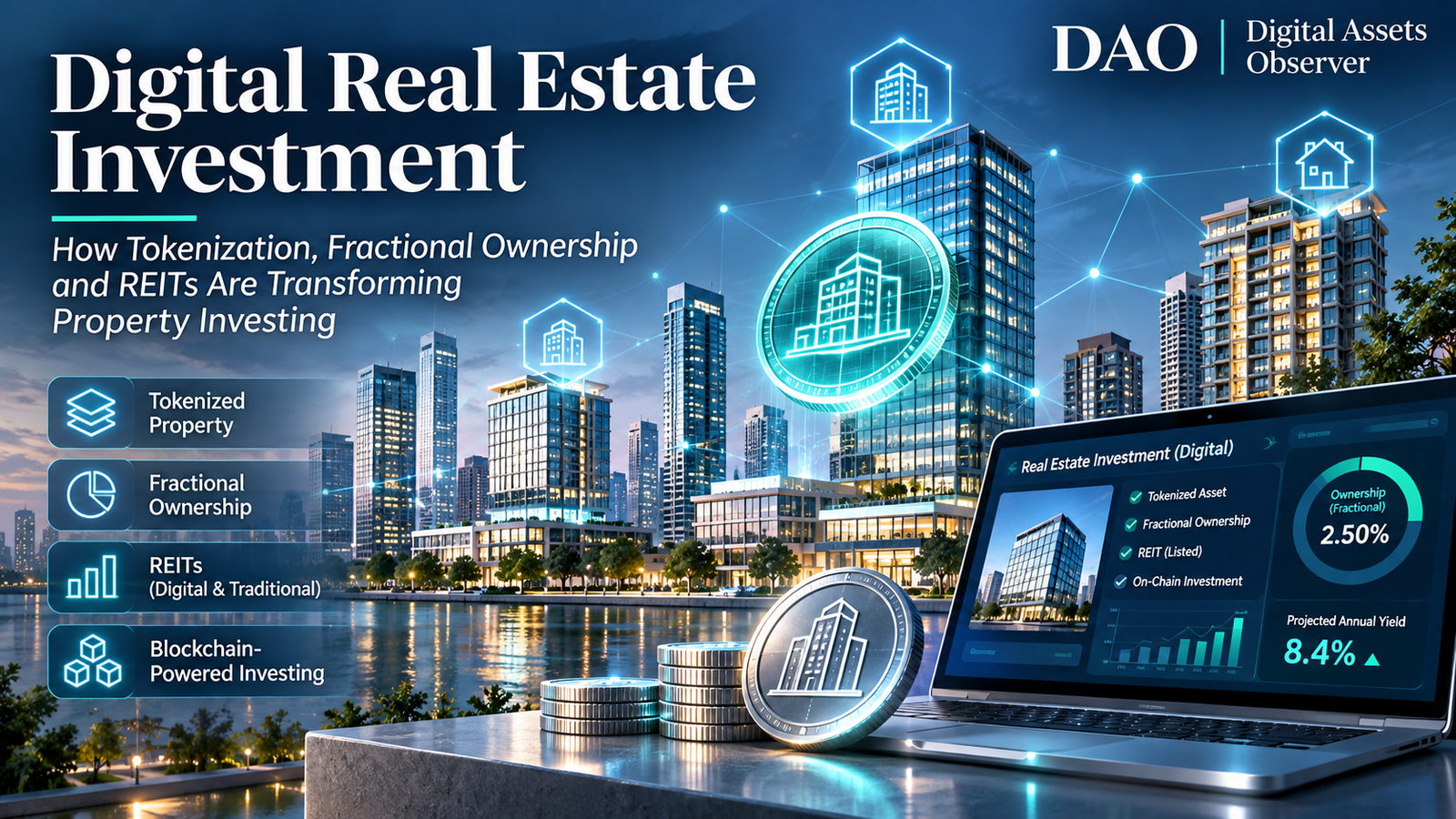
From commercial office buildings and shopping malls to blockchain-powered property tokens, digital real estate investment is opening new pathways to an asset class historically dominated by wealthy investors. But as opportunities expand, understanding ownership rights, regulation, liquidity and risk is becoming more important than ever.
Digital Assets Observer | Exclusive Analysis | November 5, 2026
The New Era of Digital Real Estate Investment
The global real estate investment landscape is experiencing a structural transformation as digital technologies increasingly intersect with property ownership, financial markets and wealth management.
For decades, real estate has been considered one of the most reliable long-term asset classes. However, investing directly in commercial property, premium residential developments or income-generating institutional assets traditionally required substantial capital.
Buying a commercial office building or an income-producing warehouse could involve investments running into millions of dollars or several crores of rupees.
Today, that investment equation is changing.
Digital real estate investment platforms, fractional ownership structures, Real Estate Investment Trusts (REITs), and blockchain-based tokenization models are creating opportunities for individuals to access real estate without necessarily purchasing an entire property.
The emerging concept is straightforward: investors acquire financial interests connected to property rather than directly buying a complete building.
Depending on the investment structure, returns may be generated through rental distributions, capital appreciation, interest payments or proceeds from the eventual sale of the underlying asset.
However, not all digital real estate products are equivalent. Some are regulated securities, others represent shares in property-holding entities, and certain blockchain-based products may provide only contractual economic rights.
This distinction is central to understanding the rapidly developing digital property investment market.
What Is Digital Real Estate Investment?
Digital real estate investment refers to using online financial platforms and digital investment infrastructure to acquire exposure to physical property or property-related financial assets.
The term encompasses several investment structures:
- Real Estate Investment Trusts (REITs)
- Fractional ownership of commercial and residential property
- Small and Medium Real Estate Investment Trusts (SM REITs)
- Blockchain-based real estate tokenization
- Real-world asset (RWA) investment platforms
- Property-backed debt and digital crowdfunding arrangements
Although these models share certain technological characteristics, their legal frameworks and investor protections can differ significantly.
For example, investors buying units of a regulated REIT generally acquire an interest in a trust that holds income-producing assets. By contrast, an investor buying a blockchain token may receive rights linked to a company, a property-financing arrangement or a contractual revenue-sharing agreement.
A token does not automatically confer ownership of the underlying land or building.
Therefore, digital access should not be confused with legal title.
Understanding Real Estate Tokenization: Converting Property Interests Into Digital Tokens
Real estate tokenization is one of the most discussed developments within the broader real-world assets sector.
Tokenization involves representing defined economic or ownership interests through digital tokens recorded on a blockchain or another programmable ledger.
The underlying asset remains a physical property, but certain rights associated with that property are represented digitally.
How real estate tokenization works
Consider a hypothetical commercial property valued at $5 million.
An investment company acquires the building and structures an investment offering that represents investors’ economic interests through 50,000 digital tokens.
Each token has an initial offering price of $100.
Subject to the investment agreement, token holders could receive a proportionate share of distributable rental income and proceeds from a future asset sale.
A simplified process could involve:
- Identifying and independently valuing a suitable property.
- Establishing a legally compliant investment vehicle.
- Defining investors’ rights through enforceable legal documents.
- Issuing digital tokens representing those rights.
- Maintaining ownership and transaction records.
- Distributing eligible income to investors.
- Facilitating transfers or secondary transactions where legally permitted.
Smart contracts may automate certain administrative activities, including token transfers, compliance checks and payment calculations.
Nevertheless, the blockchain ledger does not replace land-registration requirements, property law, custody arrangements or investor-protection obligations.
The enforceability of investors’ rights depends on the legal framework supporting the token.
Why tokenization is attracting financial institutions
Tokenization potentially offers several operational advantages:
Fractionalization: Large assets can be divided into smaller economic interests, subject to legal and regulatory limits.
Transfer efficiency: Digitized securities may enable faster processing and settlement.
Transparent transaction records: Blockchain systems can provide tamper-evident records of token movements.
Programmable administration: Smart contracts may automate distribution calculations and compliance restrictions.
Broader market participation: Digital distribution channels may reduce some of the traditional costs of accessing investment products.
These potential benefits are attracting interest from financial institutions, property investment companies, technology providers and investors.
However, faster token transfers do not necessarily make the underlying property easier to sell.
A tokenized building remains exposed to local real estate conditions, tenant demand, interest rates and asset valuation risks.
Global Real Estate Tokenization Trends in 2026
Real estate tokenization is part of a broader movement toward representing real-world assets on digital ledgers.
Real-world asset tokenization can include:
- Real estate
- Government securities
- Corporate bonds
- Private credit
- Commodities
- Investment funds
- Other legally recognized financial claims
The International Monetary Fund, in an October 2026 assessment, highlighted the potential of tokenization to reduce transaction friction and reorganize parts of the financial system.
However, the IMF also emphasized that tokenized financial markets remain relatively small and fragmented, with important questions surrounding legal certainty, governance and market resilience.
For real estate, these concerns are particularly relevant because property transactions involve local laws, ownership records, leasing agreements and physical asset management.
What research says about tokenized property
The Bank for International Settlements published research examining whether real estate tokenization can address shortcomings in traditional property markets.
The research identified real estate’s illiquidity and complex transaction processes as important motivations behind tokenization platforms.
The development of digital property investment infrastructure may improve certain aspects of accessibility and transaction efficiency.
Nevertheless, research into the sector remains at an early stage.
Tokenization should therefore be viewed as an evolving investment infrastructure rather than a guaranteed solution to real estate illiquidity.
Three major global trends
First: The growing convergence between traditional finance and blockchain.
Institutional interest is shifting toward digitizing regulated financial products and settlement processes rather than relying exclusively on speculative crypto assets.
Second: The expansion of fractional investment structures.
Technology-enabled investment platforms are making it easier to administer multiple investors in a single asset or investment vehicle.
Third: Increasing regulatory scrutiny.
Financial authorities are examining digital securities, investor custody, financial disclosures, anti-money-laundering controls and legal enforceability.
The next phase of tokenized real estate development is likely to depend as much on regulatory credibility as on technological innovation.
India’s Digital Real Estate Investment Market Is Expanding
India has emerged as an important market for technology-enabled real estate investment, particularly through regulated REITs and fractional ownership structures.
Institutional-quality office parks, commercial business districts, shopping malls and other income-generating properties have traditionally attracted major developers, financial institutions and high-net-worth investors.
REITs have helped create a publicly accessible investment route into this segment.
Six listed Indian REITs in 2026
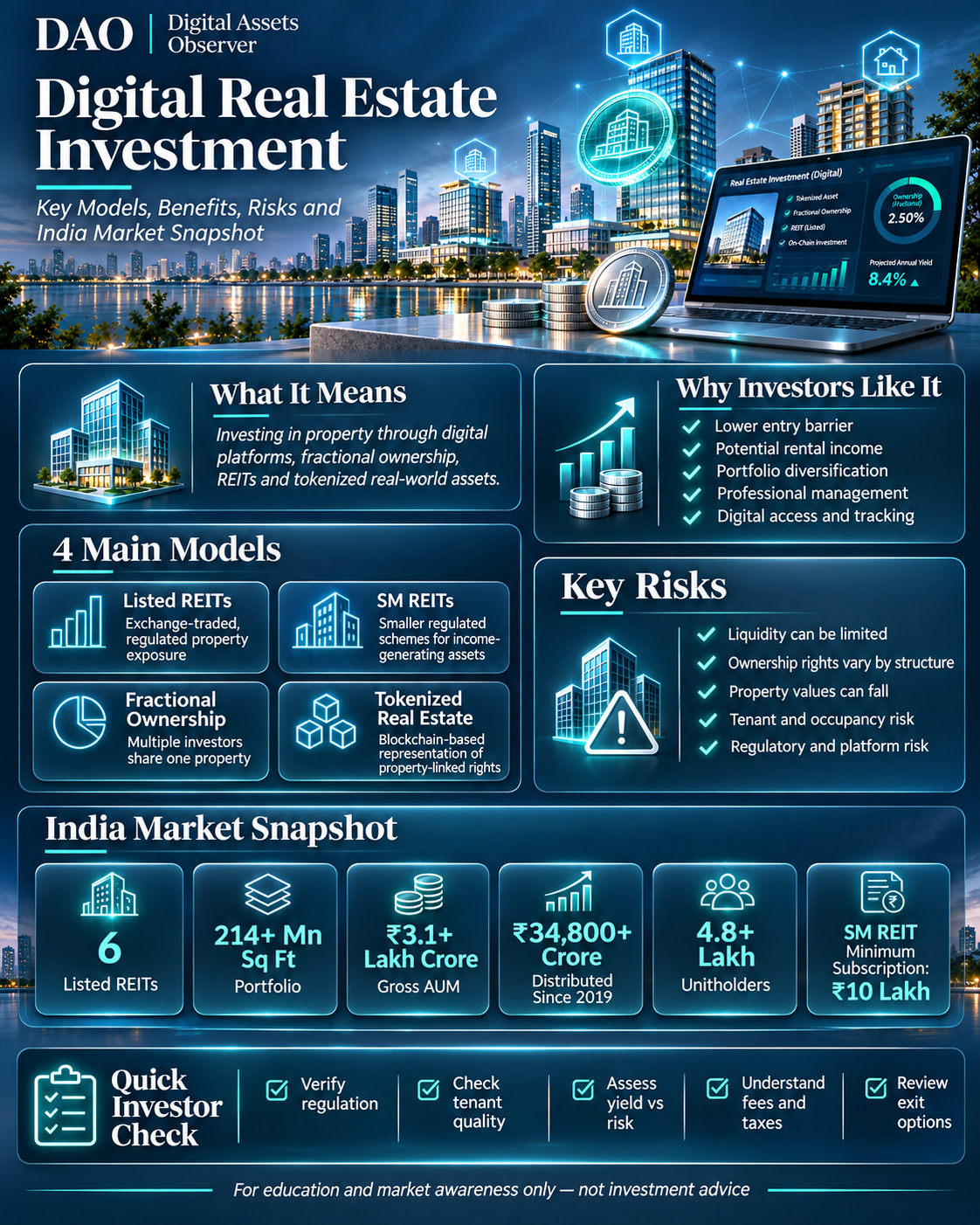
According to the Indian REITs Association, India had six listed REITs as of November 2026:
- Embassy Office Parks REIT
- Mindspace Business Parks REIT
- Brookfield India Real Estate Trust
- Nexus Select Trust
- Knowledge Realty Trust
- Bagmane Prime Office REIT
The association’s data for June 30, 2026, indicated that these REITs collectively managed more than 214 million square feet of Grade A commercial and retail space.
Their combined gross assets under management exceeded ₹3.1 lakh crore.
The industry had also distributed more than ₹34,800 crore to unitholders cumulatively since 2019.
These figures demonstrate the substantial scale achieved by listed property investment vehicles in India.
India’s REIT industry: Key numbers
| Indicator | Reported position |
|---|---|
| Listed REITs | 6 |
| Gross assets under management | Over ₹3.1 lakh crore |
| Commercial and retail portfolio | Over 214 million sq. ft. |
| Cumulative distributions since 2019 | Over ₹34,800 crore |
| Investor base | Over 4.8 lakh unitholders |
| Reference period | June 30, 2026 |
Source: Indian REITs Association. Figures are industry-wide historical indicators, not projections of future investment returns.
This growth is important for investors seeking an alternative to directly purchasing residential or commercial property.
Rather than managing an individual building, investors can purchase units of an investment vehicle professionally managed under a regulatory framework.
How REITs Work and Why They Matter
A Real Estate Investment Trust is an investment structure that holds or finances eligible income-producing real estate.
Investors acquire units of the trust and participate in its economic performance.
In India, publicly listed REIT units can generally be purchased through registered stockbrokers using a demat and trading account.
The investment experience resembles purchasing an exchange-listed security, although the underlying business model is linked to property assets.
REITs may generate income through rent, property-related activities and other permitted sources.
After operating costs, financing expenses and other obligations, eligible cash flows are distributed in accordance with regulatory requirements.
Indian REITs operate under Securities and Exchange Board of India regulations, including requirements concerning assets, disclosures and distribution of net distributable cash flow.
What investors should examine before buying REIT units
Rental income alone does not determine investment quality.
Important variables include:
- Portfolio occupancy
- Tenant diversification
- Weighted average lease expiry
- Rental escalation clauses
- Debt and borrowing costs
- Net asset value
- Distribution history
- Asset valuation
- Property location
- Management fees
- Acquisition and development strategy
A REIT with a high reported distribution yield may not necessarily be an attractive investment if its properties are experiencing vacancies, declining demand or increasing financing costs.
Similarly, a REIT trading at a premium to its estimated net asset value may offer limited valuation protection.
Small and Medium REITs: India’s Regulated Fractional Real Estate Model
A particularly important development in India has been the establishment of a regulatory framework for Small and Medium Real Estate Investment Trusts, commonly known as SM REITs.
Introduced through SEBI’s REIT regulatory framework in 2024, the structure was designed to facilitate regulated investment in comparatively smaller income-generating real estate assets.
SM REIT schemes can provide access to specified property assets through regulated investment structures.
Unlike large diversified REITs, individual SM REIT schemes may concentrate their investments in a single property or a relatively small asset portfolio.
That concentration makes due diligence especially important.
Minimum investment in SM REITs
The SEBI framework prescribes a minimum subscription amount of ₹10 lakh for an investor in an initial or subsequent offer, unless modified through applicable regulatory provisions.
This means SM REITs should not be confused with digital platforms promising property investments starting at only a few thousand rupees.
An online investment dashboard does not automatically make an offering an SM REIT or establish SEBI regulatory oversight.
Examples of registered SM REIT entities
SEBI’s registered intermediary records include entities such as:
- Property Share Investment Trust
- hBits Investment Trust
- Amsa Small and Medium Real Estate Investment Trust
- EMBERSTONE SM REIT
- IMPACT R SM REIT
- Yield Foundry SM REIT
- TreBits Investment Trust
The appearance of an entity in SEBI’s registered SM REIT list does not establish that every product associated with its business group is a regulated investment offering.
Investors should verify the specific scheme, registration, offer document and exchange status independently.
REITs vs Fractional Ownership vs Tokenized Real Estate: What Is the Difference?
Although these investment approaches are often grouped under digital real estate, they operate differently.
| Parameter | Listed REITs | Private Fractional Ownership | Tokenized Real Estate |
|---|---|---|---|
| Investment exposure | Units of a real estate trust | Interest in a property-holding structure | Digitally represented legal or economic rights |
| Blockchain required | No | No | Generally yes |
| Regulation | SEBI-regulated in India | Depends on structure | Depends on jurisdiction and token rights |
| Minimum investment | Exchange unit price | Platform dependent | Offering dependent |
| Income potential | Distributions | Rental or contractual income | Depends on token rights |
| Exit route | Stock exchange | Contractual resale or asset exit | Permitted token transfer or redemption |
| Main concern | Market, property and interest-rate risks | Liquidity and structural risks | Legal rights, custody, platform and liquidity risks |
For many retail investors, listed REITs offer a more established route to real estate exposure.
Private fractional ownership and tokenization may provide more direct exposure to specific assets but demand closer examination of ownership structures and exit provisions.
Can Investors Earn Regular Income Through Digital Real Estate?
Income generation is one of the principal attractions of commercial real estate investing.
A leased office building or retail property can generate rental income from tenants.
After property expenses, management costs, financing obligations, reserves and other deductions, a portion of available cash flow may be distributed to investors.
However, the actual amount and frequency depend on the investment structure.
Illustrative investment example
Consider an investor who allocates ₹5 lakh to a hypothetical property-related investment product.
Assume the investment provides an annual cash distribution equivalent to 6% of the initial investment and the underlying investment value grows by 4% annually.
| Financial parameter | Illustration |
|---|---|
| Initial investment | ₹5,00,000 |
| Annual cash distribution at 6% | ₹30,000 |
| Five-year cumulative distributions | ₹1,50,000 |
| Estimated investment value after five years at 4% annual growth | ₹6,08,326 |
| Combined proceeds including distributions | ₹7,58,326 |
| Illustrative overall gain | ₹2,58,326 |
This hypothetical calculation assumes constant annual cash distributions, reinvestment of none of those payments, annual compounding of investment value, and a successful exit after five years.
It excludes transaction costs, taxes, fees, vacancies and other real-world variables.
The assumed return is not a market forecast or promised yield.
Importantly, property values can decline and distributions can fall or stop.
Is Digital Real Estate Better Than Physical Property Investment?
The answer depends on investment objectives, available capital, investment horizon and the degree of control required.
Advantages of digital investment structures
Lower capital requirement: Certain listed property securities can be acquired with substantially less money than purchasing a complete property.
Reduced property-management responsibility: Investors do not normally need to manage tenants or building maintenance directly.
Diversification potential: A diversified REIT can provide exposure to multiple properties and tenants.
Professional management: Regulated structures appoint investment managers and operate under disclosure obligations.
Convenient access: Digital brokerage and investment platforms can simplify account management, reporting and transactions.
Advantages of direct property ownership
Physical property owners may exercise greater control over leasing, renovation, financing and eventual sale decisions.
Direct ownership may also offer specific personal-use advantages that financial securities do not provide.
However, purchasing a complete property usually involves higher capital commitments, stamp duty, registration expenses, ongoing maintenance and potentially lengthy sale processes.
Neither approach is automatically superior.
Digital investments replace some operational responsibilities with dependence on investment managers, platforms, market pricing and legal structures.
The Biggest Risks Investors Must Understand
Despite its growth potential, digital real estate investment involves substantial risks.
1. Liquidity risk
Fractional investments or tokens may lack an active secondary market.
Even if tokens are technically transferable, there may be few willing buyers.
2. Legal ownership risk
Investors must establish whether they own a share of a trust, company, special-purpose vehicle, debt instrument or contractual claim.
A digital token alone may not provide enforceable rights over the property.
3. Property valuation risk
Commercial property values can change because of interest rates, tenant departures, economic conditions or changes in neighborhood demand.
4. Tenant and rental risk
A property dependent on one major tenant could experience substantial income disruption if the tenant vacates.
5. Technology and custody risk
Tokenized investments may depend on digital wallets, smart contracts, administrators and custody systems.
Cybersecurity weaknesses or operational failures could compromise access or cause losses.
6. Regulatory risk
Laws covering digital securities and tokenized ownership vary internationally.
A product legally offered overseas may not be freely marketed or purchased by Indian residents.
7. Currency and taxation risk
Cross-border investments expose investors to exchange-rate changes, tax obligations and applicable foreign-investment regulations.
Before committing money, investors should obtain clarity about applicable Indian tax laws and any overseas reporting requirements.
How Indian Investors Can Start Investing in Digital Real Estate
For individuals exploring this asset class, a disciplined approach can reduce avoidable mistakes.
Step 1: Define the investment objective
Determine whether the principal goal is regular income, long-term capital growth, portfolio diversification or exposure to emerging blockchain technology.
Step 2: Select an appropriate investment structure
Investors seeking regulated, exchange-traded exposure may begin by researching listed REITs.
Those considering property-specific SM REIT schemes must understand their significantly higher initial subscription requirement and concentration risks.
Step 3: Verify regulatory status
For Indian investment products, consult official SEBI records and exchange disclosures.
Do not assume regulatory approval merely because a platform uses terms such as blockchain, digital assets or fractional property ownership.
Step 4: Analyze the underlying property
Study location, occupancy, tenant financial strength, rental agreements, maintenance expenses and independent asset valuations.
Step 5: Examine the projected return
Separate recurring cash distributions from anticipated capital appreciation.
Projected exit valuations should be treated as assumptions rather than guaranteed outcomes.
Step 6: Understand fees and taxation
Assess acquisition fees, management charges, transaction expenses, financing costs and taxes.
For REIT distributions, the tax treatment can differ between components such as interest, dividends and repayment of capital.
Step 7: Establish an exit strategy
Before investing, determine whether units are traded on an exchange, can be transferred privately, are subject to lock-ins or depend on the eventual sale of the underlying property.
Liquidity should be assessed before investment, not only when money is urgently needed.
Real Estate Tokenization and Blockchain: What Happens Next?
The long-term implications of tokenization extend beyond smaller investment denominations.
Programmable financial infrastructure may eventually change how property-backed securities are issued, administered, transferred and settled.
Digital identity systems could support investor verification.
Automated compliance systems could reduce certain administrative processes.
Shared ledgers could improve reconciliation between authorized market participants.
Integration with regulated payment and settlement systems could make distributions and transfers more efficient.
Nevertheless, the property itself will continue to exist within conventional legal and economic systems.
Buildings must be maintained, tenants must pay rent, property titles must be enforceable, and valuations must reflect market conditions.
Technology can improve the infrastructure surrounding real estate investment, but it cannot eliminate fundamental property-market risks.
This creates an opportunity for established financial institutions, real estate developers, investment managers and fintech companies to build more transparent and operationally efficient investment products.
Explore digital real estate investment in 2026, including tokenized property, fractional ownership, REITs, returns, risks and opportunities in India.
Why Digital Real Estate Could Become an Important Investment Theme
Several structural developments may support further growth in digitally accessible real estate investments.
Institutional demand for income-producing commercial property remains an important foundation for REIT markets.
Digital brokerage infrastructure is expanding access to investment securities.
Regulated fractional ownership frameworks are developing.
Meanwhile, asset managers and financial institutions continue to explore programmable securities and digital settlement systems.
For investors, these developments could expand the range of available property-linked financial instruments.
For real estate companies, they may create additional financing and distribution channels.
For financial technology providers, they represent opportunities in asset administration, compliance, custody and investment management software.
However, adoption is unlikely to progress uniformly across markets.
Differences in property law, taxation, securities regulations and investor behavior will influence how quickly different tokenization structures become commercially viable.
Frequently Asked Questions About Digital Real Estate Investment
What is digital real estate investment?
Digital real estate investment involves acquiring exposure to physical property or property-linked financial assets through online platforms, exchange-traded securities, fractional ownership vehicles or blockchain-based instruments.
Can I invest ₹10,000 in digital real estate in India?
Investors may be able to purchase units of listed REITs within that budget, depending on market prices and trading requirements. However, SEBI-regulated SM REIT initial offers generally require a minimum subscription of ₹10 lakh under the applicable framework.
Is real estate tokenization legal in India?
The legal position depends on the specific instrument and transaction structure. India’s regulated REIT and SM REIT frameworks should not be confused with a blanket authorization for blockchain property tokens. Any offering must be evaluated under applicable securities, property, foreign-exchange and other laws.
Can tokenized real estate generate rental income?
Potentially, yes. Some structures distribute income connected to underlying rental operations. However, distributions depend on actual property cash flows, contractual investor rights, operating expenses and investment terms.
Is digital real estate investment safer than cryptocurrency?
Not necessarily. A regulated REIT differs substantially from a speculative crypto token, but both involve investment risks. Tokenized property interests may carry additional technological, custody, liquidity and legal uncertainties.
Do I legally own a property when I purchase a real estate token?
Not automatically. Investors may own securities or contractual rights issued by a property-holding entity rather than registered title to the land or building.
Which is better: REITs or tokenized property?
Listed REITs generally provide a more established regulatory and exchange-trading framework for Indian investors. Tokenized property may offer technological innovation or targeted asset exposure, but it requires additional due diligence concerning enforceable rights and liquidity.
Is fractional real estate a good long-term investment?
It may serve certain long-term investment objectives, but suitability depends on the property, valuation, tenant quality, financing arrangements, management competence, fees and exit opportunities.
The Future of Property Investing Is Becoming More Digital
Digital real estate investment is reshaping how investors access one of the world’s most established asset classes.
From listed REITs to regulated fractional ownership and emerging blockchain tokenization models, technological innovation is expanding the mechanisms through which property-related financial interests can be acquired and administered.
India’s expanding REIT market demonstrates how institutional real estate can become accessible through capital-market structures.
At the same time, international developments in real-world asset tokenization suggest that programmable investment infrastructure could eventually influence property financing, asset administration and securities settlement.
Yet the central principle of successful real estate investing remains unchanged.
Investment outcomes depend on the quality of the underlying assets, realistic valuations, sustainable income, enforceable legal rights and prudent risk management.
For investors considering this emerging opportunity, the relevant question is not simply whether real estate can be purchased digitally.
It is whether the digital investment structure offers transparent ownership rights, dependable governance, reasonable costs and a credible path to earning and recovering invested capital.
The future of real estate investment may increasingly be digital, but the foundation of sound investment will remain financial discipline, regulatory clarity and genuine asset value.
Research Sources and Further Reading
- Securities and Exchange Board of India – REIT Regulations, amended April 18, 2026
- Indian REITs Association – Knowledge Centre and Industry Statistics
- SEBI – Registered SM REITs
- IMF – What Is Needed for Tokenization to Deliver, October 2026
- Bank for International Settlements – When Bricks Meet Bytes: Real Estate Tokenization Research
- SEBI Investor Education – Understanding REITs and InvITs
Editorial Disclaimer: This article is published by Digital Assets Observer for financial education, market awareness and informational purposes. It does not constitute investment advice, a solicitation, or a recommendation to purchase or sell any security, digital token, property interest or investment product. Real estate and digital asset investments are subject to market, regulatory, legal, liquidity and operational risks. Readers should consult appropriately qualified financial, legal and tax professionals before making investment decisions.












Leave a Reply