

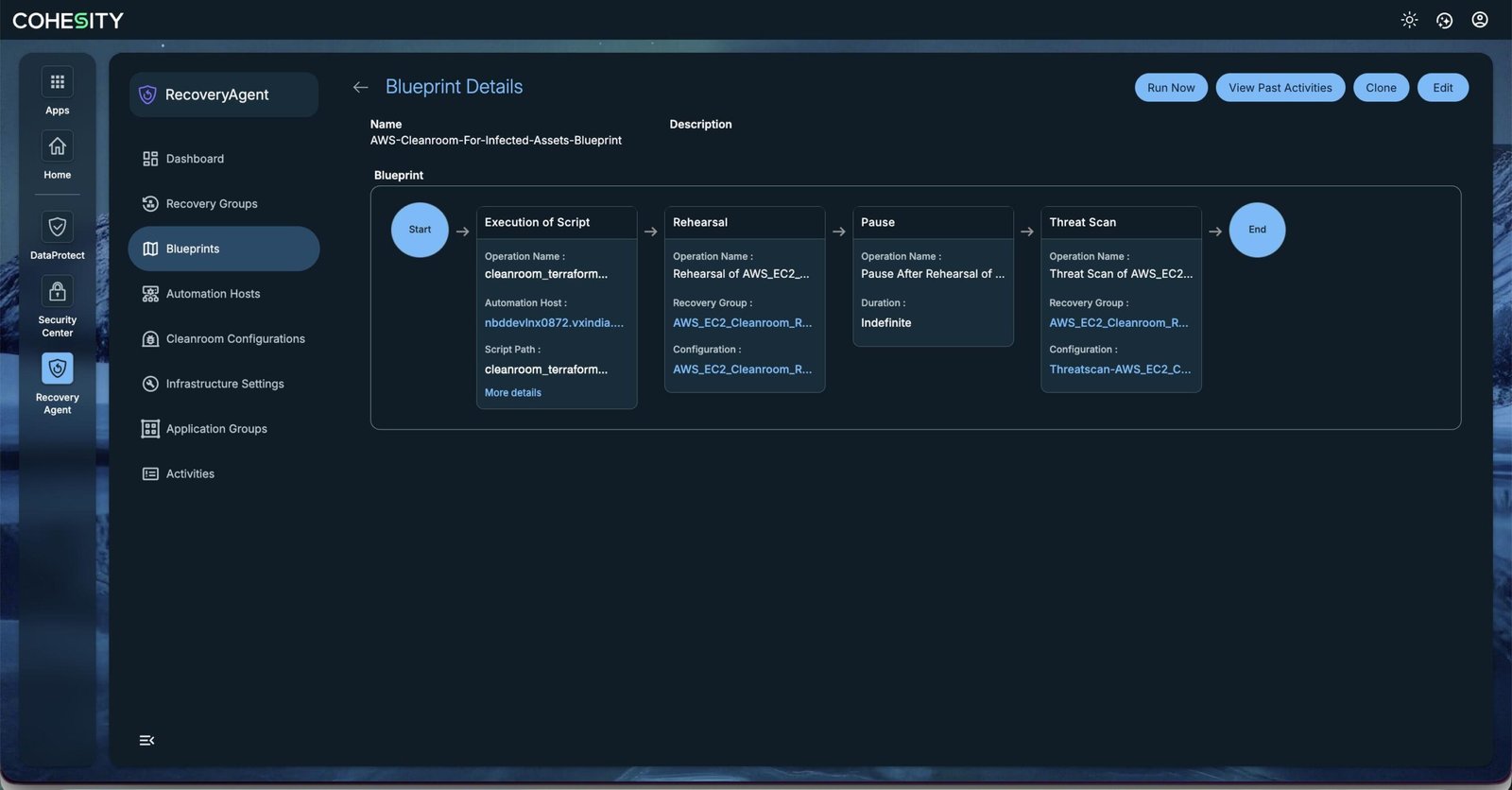
Data security company Cohesity has announced that HashiCorp, an IBM company, has validated interoperability between Cohesity Data Cloud’s cloud rebuild capabilities and Terraform Self-Managed.
The development is aimed at helping organisations restore cloud applications following destructive cyberattacks by combining infrastructure reconstruction with the recovery of backed-up application data.
As businesses become increasingly dependent on cloud-hosted applications, the ability to restore services after a security incident has become a central component of operational resilience.
Why Cloud Recovery is Becoming More Complicated
Traditional backup strategies often concentrate on preserving data. However, recovering a modern cloud application may require much more than restoring files or databases.
Applications depend on networks, servers, permissions, configuration settings and numerous interconnected cloud services.
When attackers compromise these components, restoring the latest copy of an environment may not necessarily return the organisation to a trusted configuration.
Cohesity’s newly validated approach is intended to address this problem by separating the reconstruction of cloud infrastructure from the restoration of application data.
How the Integration Works
Terraform is an infrastructure-as-code technology that allows organisations to define cloud resources using configuration files.
These files describe the intended infrastructure environment and can be used to create or recreate resources.
Under the announced integration, Terraform reconstructs the declared cloud configuration while Cohesity restores application data from an appropriate backup.
This approach is designed to help administrators recover applications using previously reviewed infrastructure definitions rather than rebuilding compromised environments entirely by hand.
Four important recovery capabilities
The announced solution includes several stages.
Application mapping: Cohesity reads Terraform configuration to identify cloud resources and understand their dependencies.
Protection of trusted versions: Infrastructure definitions and application data are backed up so recovery teams can select suitable restore points.
Infrastructure reconstruction: Terraform recreates the declared configuration, after which Cohesity restores the selected application data.
Recovery-point visibility: Administrators can examine timing differences between infrastructure and data backups.
That final capability matters because infrastructure definitions and application data may be protected on different schedules.
An organisation must understand those differences before deciding which recovery point is appropriate.
AI-driven cyber threats increase the urgency
Cohesity also cited findings from its 2026 Global Cyber Resilience Report, based on research involving 3,200 security and IT decision-makers.
According to the company, 83% of surveyed organisations believed their recovery plans would require moderate or significant changes to address attacks using AI to identify and exploit vulnerabilities.
Only 3% said their recovery plans were ready for such attacks.
These are survey findings reported by Cohesity, rather than a direct measure of all organisations’ preparedness.
Nevertheless, the results highlight the concern that increasingly automated attacks could outpace traditional recovery procedures.
What this means for enterprises
For companies operating critical applications in the cloud, recovery planning increasingly needs to account for the integrity of the infrastructure itself.
An effective recovery strategy must consider configuration security, backup protection, application dependencies and the sequence in which systems are restored.
The Cohesity-Terraform approach could be particularly relevant to organisations already using infrastructure-as-code practices.
However, successful implementation will still require testing, secure backup management and careful integration with existing incident-response procedures.
Availability and business significance
Cohesity says its cloud rebuild capabilities are available through Cohesity Data Cloud Enterprise Edition.
Existing customers using Data Protect or Cohesity NetBackup may access the capabilities through an upgrade to Enterprise Edition.
The announcement illustrates a wider cybersecurity trend: recovery technologies are moving beyond data restoration toward coordinated rebuilding of complete application environments.
For enterprises facing increasingly sophisticated cyber threats, the ability to recover a known configuration and usable application data could become an important consideration in cloud infrastructure planning.
Tags: Cohesity, IBM, HashiCorp, Terraform, Cloud Security, Cyber Recovery, Data Protection, Enterprise Technology














Leave a Reply