
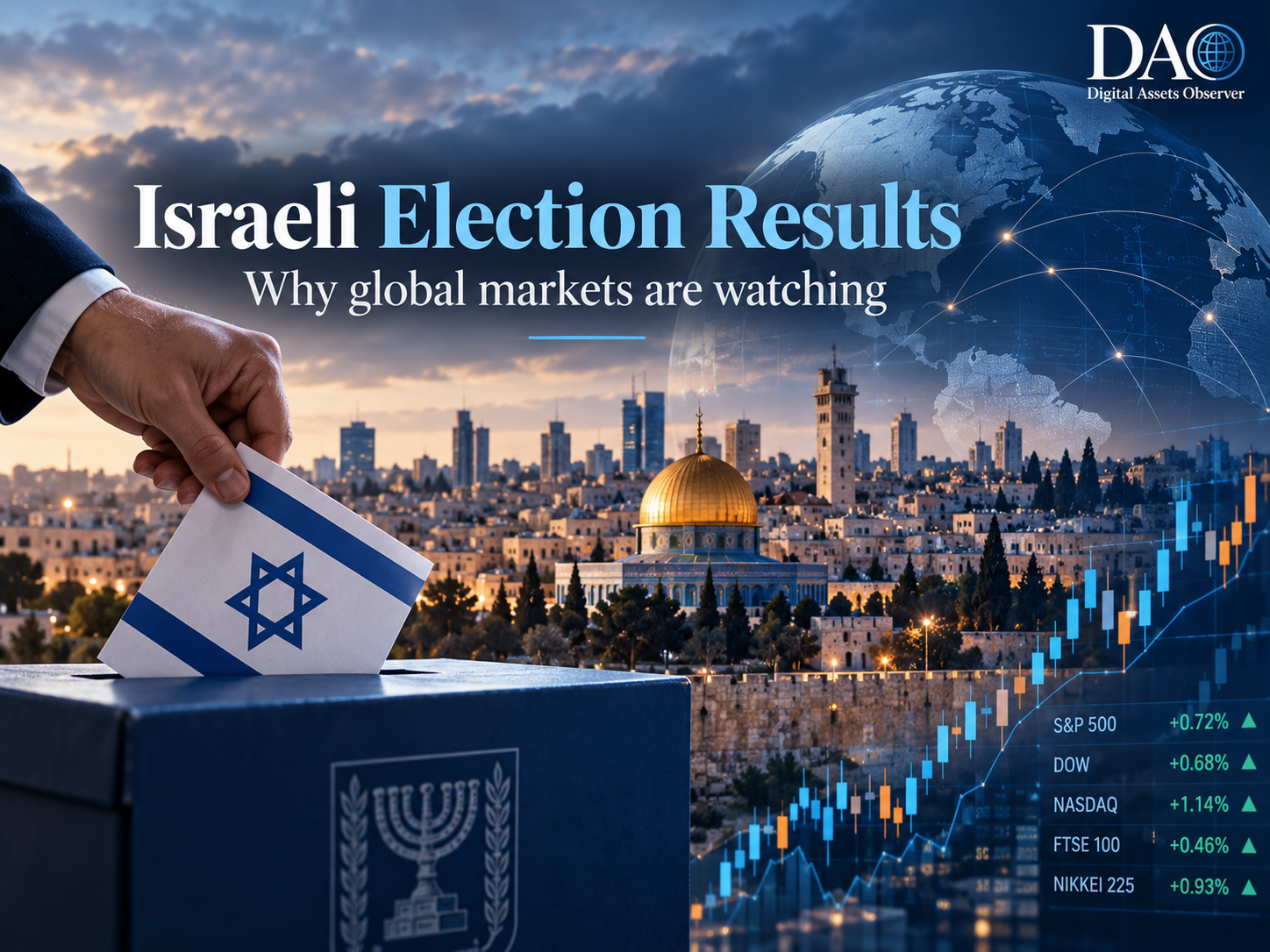
Israel’s parliamentary election has produced a fragmented political picture, with coalition negotiations expected to determine the country’s next government.
New Delhi, October 29, 2026: Israel’s October 27 parliamentary election has attracted international attention as investors and policymakers assess the implications of political uncertainty in a region central to global energy security and geopolitical developments.
Vote-counting updates have indicated that no major political bloc has independently secured the 61 seats required for a majority in the 120-member Knesset.
Results reported on October 28 placed Prime Minister Benjamin Netanyahu’s bloc at approximately 53 seats, an opposing grouping at 48 seats and Arab-led parties at 19 seats.
As additional votes were counted on October 29, some projections shifted modestly, but the central political challenge remained unchanged: forming a governing majority.
For global markets, the immediate question is not simply which political party emerges ahead but whether a stable government can be formed and how future policy decisions might affect regional security and economic relations.
Israel Election 2026: What the Results Indicate
Israel operates a parliamentary political system in which governments generally depend on coalition arrangements.
A party or bloc must obtain support from at least 61 members of the Knesset to command a majority.
The preliminary election picture indicates that the major political groupings face difficult coalition negotiations.
Netanyahu’s political bloc has remained a significant force, but the available projections do not show an automatic parliamentary majority.
Opposition parties also face challenges in assembling sufficient support.
Arab-led parties have emerged as important participants in the parliamentary arithmetic.
Their potential role in negotiations could become significant, although the specific arrangements required to form a government remain uncertain.
Election counts and seat projections should not be confused with the final formation of a government.
Why the Outcome Matters Internationally
Israel occupies an important position in Middle Eastern geopolitical affairs.
Its political decisions can influence diplomatic relations, regional security arrangements and cooperation with international partners.
The election follows a period of intense political debate involving national security, military policy and the country’s international position.
These issues have implications beyond Israel’s domestic political system.
Changes in regional security conditions may influence investor sentiment and the willingness of businesses to undertake long-term commitments.
However, political uncertainty does not automatically lead to a financial-market crisis.
The economic consequences depend on the decisions taken by political leaders and the response of regional and international actors.
Global Oil Markets and Middle East Risk
The Middle East plays an important role in international energy markets.
Although Israel is not among the world’s largest oil exporters, regional security developments can influence perceptions of supply risk.
Oil prices may respond to concerns involving shipping routes, energy infrastructure, production facilities and the possibility of wider conflict.
However, price movements are also influenced by global demand, inventories, production decisions and broader economic conditions.
Investors should therefore avoid attributing every change in oil prices directly to Israeli political developments.
The election’s energy-market implications will depend on whether it contributes to changes in regional stability or policy.
Potential Implications for India
India maintains important economic relationships with multiple countries across the Middle East.
Energy imports, international trade, logistics and investment flows connect the Indian economy with broader regional developments.
For Indian businesses, geopolitical uncertainty can influence planning when it affects transport routes, insurance costs or energy prices.
However, the actual effect depends on the scale and duration of any disruption.
Investors should distinguish between potential risks and confirmed economic changes.
The election result alone does not establish that Indian businesses will experience higher costs or reduced trade.
Defence and Technology Relations
India and Israel have established cooperation across technology and defence-related sectors.
Israel is known for its advanced technology ecosystem, including cybersecurity, digital infrastructure and specialised engineering capabilities.
Political developments can shape national priorities and international partnerships, although existing commercial relationships often continue across changes in government.
Businesses and investors following technology cooperation should monitor actual policy announcements, procurement decisions and corporate disclosures.
Speculation about potential changes should not be treated as confirmed business developments.
How Global Financial Markets Respond to Geopolitical Uncertainty
Financial markets frequently react to uncertainty through changes in expectations.
Investors may reconsider their exposure to sectors that are sensitive to energy costs, international trade or security developments.
Currency markets, commodity prices and equity valuations can all be influenced by changes in perceived risk.
However, the relationship is not always straightforward.
A political development may attract considerable media attention without causing a lasting financial-market movement.
Investors should therefore focus on observable price changes, economic indicators and company-specific fundamentals rather than headlines alone.
What Indian Investors Should Monitor
Several indicators may provide a clearer picture of the potential financial implications.
First, international crude oil prices can help identify whether energy markets are responding to regional developments.
Second, currency movements may indicate changes in broader global risk sentiment.
Third, official diplomatic statements and regional security developments may help investors understand whether political uncertainty is translating into operational or economic risks.
Finally, investors should monitor the financial performance and international exposure of individual companies.
A diversified investment approach can help reduce the risks associated with reacting to single geopolitical events.
The Importance of Coalition Negotiations
The next phase of Israel’s political process will involve efforts to establish a government capable of securing parliamentary support.
Possible outcomes include a negotiated coalition, broader political arrangements or continued uncertainty if negotiations fail.
The final outcome will depend on discussions among parties and decisions made through the country’s constitutional and parliamentary processes.
For international observers, the eventual government’s policy direction may be more consequential than the initial election-night projections.
Frequently Asked Questions
When was Israel’s 2026 parliamentary election held?
The election took place on October 27, 2026.
Did any bloc win a clear majority?
The vote-counting updates available on October 29 did not indicate an independently secured 61-seat majority.
Can Israel’s election affect global oil prices?
Political developments can influence energy-market sentiment, particularly if they affect regional security. However, oil prices depend on several additional economic and supply factors.
Should Indian investors change portfolios because of the election?
A political event alone is not sufficient grounds for an investment decision. Investors should assess actual economic developments, portfolio exposure and financial fundamentals.
Conclusion
Israel’s 2026 election has created a complex political situation in which coalition negotiations will play a decisive role.
The results have attracted international attention because of Israel’s geopolitical position and the wider significance of Middle Eastern security.
For financial markets, the most important developments will be those that translate political uncertainty into measurable economic or commercial consequences.
Indian investors and businesses should remain informed while avoiding decisions based solely on speculative geopolitical scenarios.
Editorial Note: Seat counts and coalition projections were provisional at the time of writing and may change as counting and political negotiations proceed.
Disclaimer: This article provides general information and analysis and should not be interpreted as a recommendation to trade any security or commodity.












Leave a Reply